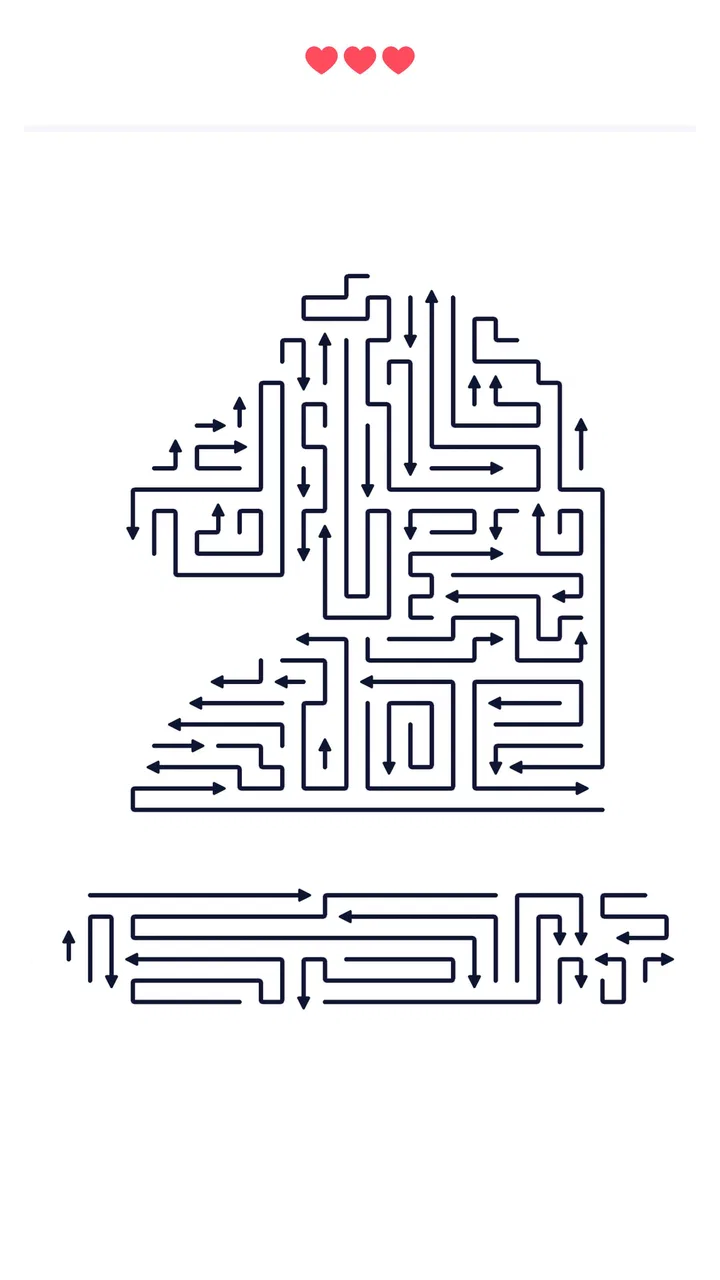
Arrows – Puzzle Escape
- 4.7
- Rating
- 100.00M
- Installs
- Free
- Price

 Analysis by App-foxy
I spent time with Arrows – Puzzle Escape as a compact logic game, and my first impression was that it understands the value of a simple rule. The board asks me to clear arrows, but the real task is reading the order of movement correctly. That sounds easy until a crowded layout turns one careless tap into a blocked route. The result is a puzzle experience that is quick to understand, but much more deliberate to solve.
This is a free puzzle game from Lessmore UG, aimed at Everyone and available for Android devices running Android 6.0 or later. It has reached over five million installs and holds a 4.6 average from around sixty-seven thousand ratings, which gives it a substantial player base without changing the fact that its appeal depends on a very personal question: do you enjoy working through visual logic one small decision at a time?
I would recommend it to someone who wants short brain-teasing sessions rather than a story-heavy adventure or a competitive game. I would be more cautious with it for players who need constant novelty, deep narrative rewards, or a generous sense of momentum. Its strongest feature is the puzzle itself, and that also defines its limits.
You May Also Like

 AccuWeather: Weather Radar
AccuWeather Review: A Quick, Clear Forecast for Everyday Decisions
For everyday plans, the best forecast is the one you can understand quickly. AccuWeather makes rain timing, radar, and local conditions easy to act on, with a few trade-offs.

 Hill Climb Racing
Why Hill Climb Racing Still Turns Crashes Into One More Run
A tiny car, a bumpy hill and one more upgrade: Hill Climb Racing keeps resurfacing because its simple chaos makes every near-miss feel personal.

 AliExpress - Shopping App
AliExpress Makes Global Shopping Feel Personal, but Shoppers Bear the Risk
AliExpress turns a global marketplace into a pocket-sized discovery engine. Its reach is useful, its shopping loop compelling, and its trade-offs easy to miss.

 Lords Mobile: Kingdom Wars
Lords Mobile Is a Kingdom-Building Routine, Not a Quick Match
A case-by-case verdict on the building, battles, device demands, and social commitments that make Lords Mobile rewarding for some players and exhausting for others.

 PDF Scanner app - TapScanner
TapScanner Makes Paperwork Easier to Capture, Check, and Share
TapScanner makes scanning with a phone feel less like a rescue operation and more like a dependable step in getting work done. Its capture tools are useful, though not flawless.

 Block Blast!
 Shows How Much a Puzzle Game Can Leave Out
A quiet grid game shows why puzzle players increasingly value instant clarity, repeatable skill and low-pressure play—and where the genre still needs to catch up.
More From Our News Desk
View All News


Why the first puzzles work so well
The early goal is immediately readable: clear the arrows from the board. I never needed a long explanation to understand what success looked like. That directness matters on a phone, where I may open a game while waiting for a coffee or during a short break and want to start playing without learning a complicated control scheme.
The opening experience is built around observation rather than speed. I look at the direction of each arrow, identify which pieces have a free path, and decide whether moving one will expose another. The satisfying part is that the board gradually reveals its logic. A move that seems unimportant can create the opening needed for a later arrow, so the game rewards planning instead of frantic tapping.
That makes the first goals feel useful rather than decorative. Clearing a board is not only about reaching the end; it is also about learning how the game expects me to read space. I began to notice that the best first move was often not the most obvious arrow. The better choice was usually the one that reduced congestion or protected a future route.
For a casual player, this low barrier is a genuine strength. I can play with one hand, stop after a completed puzzle, and return later without remembering a plot or a large set of rules. The trade-off is that anyone looking for a broad collection of mechanics may find the opening deliberately narrow.
One practical tip helped me more than I expected: before touching anything, I scan the edges of the board. Arrows with an immediately open direction are often useful starting points, but I do not automatically move every available piece. I first check whether an apparently free arrow is blocking a more important line. This small pause turns the experience from trial and error into a repeatable solving routine.
Small victories create the first rhythm
The game’s early rhythm comes from completing one contained problem and then facing another arrangement. That structure suits short sessions because each board gives me a clear stopping point. I do not have to commit to a long run to feel that I have made progress.
There is also a useful mental shift after the first few boards. At the beginning, I focus on individual arrows. Later, I start thinking about lanes, clusters, and the order in which the board can be emptied. That change is important because it gives the simple rule more depth without requiring the game to add a large number of visible systems.
I found the best early sessions were not necessarily the fastest ones. Taking a few seconds to map the likely sequence reduced mistakes and made successful clears feel earned. If you prefer games that constantly reward rapid reactions, this may feel slow. If you enjoy spotting patterns, the calm pace is a good match.
How progress feels when the board gets busier
The most convincing progress signal is the changing complexity of the puzzles themselves. A cleared board tells me I solved the immediate problem, but the more meaningful sign is that I begin to recognize why a solution works. I am no longer simply looking for an arrow that can move; I am looking for the sequence that keeps later options alive.
That distinction gives the game a modest but real learning curve. My improvement comes from better visual judgment, not from collecting stronger tools or building a character. This is an important point for expectations: the progression is primarily in the player. If you want upgrades, equipment, or a growing avatar, this is not designed around those pleasures.
The current version is 0.9.0, and I experienced the game as a focused puzzle product rather than a sprawling platform with many unrelated activities. That focus helps the central challenge stay clear. It also means that the feeling of advancement depends heavily on whether the board layouts continue to make me think in new ways.
A useful workflow is to separate planning from execution. I first identify arrows that can move without affecting anything else, then I look for pieces whose removal opens a blocked direction. Only after that do I commit to a sequence. When I make a mistake, I try to understand which assumption was wrong instead of immediately repeating the same taps. This makes failed attempts informative.
Another non-obvious strength is how the game can work as a reset between demanding tasks. I used it best when I wanted something more engaging than scrolling but less absorbing than a long-form game. A few boards can provide a mental change of pace, especially when I treat the puzzle as a visual exercise rather than a test of speed.
That same use case reveals a limitation. Because the experience is centered on one recognizable puzzle idea, the novelty can depend on the arrangement in front of me. Players who quickly master the underlying pattern may feel that the progress signals become less exciting, even if the puzzles remain satisfying.
The difficulty curve rewards patience more than reflexes
The challenge becomes more interesting when several arrows compete for the same space. At that point, a legal move is not necessarily a good move. I have to consider what the board will look like after the arrow leaves and whether I am creating a dead end for myself. This is where the puzzle stops feeling like a simple clearing exercise and starts asking for genuine sequencing.
I appreciate that kind of difficulty because it is readable. When I fail, I can usually trace the problem to a poor order or an incomplete scan. The game does not need to rely on hidden knowledge to make me feel challenged. The board gives me the information; my job is to interpret it correctly.
Still, the experience may not suit everyone. Some players want a difficulty curve that changes through new rules, timed pressure, or dramatic surprises. Here, the tension comes from increasingly careful decisions within the arrow-clearing format. That can be elegant, but it can also feel repetitive if the core visual logic does not hold your attention.
My advice is to resist tapping the first available option when a board looks crowded. Instead, trace a few possible routes mentally. I found that the safest move was often the one that preserved flexibility, not the one that removed the largest-looking obstacle. In puzzle terms, keeping several future choices open is more valuable than making one impressive-looking clear.
This is also where screen size matters in practical use. On a smaller phone, a dense layout can demand more concentration because I am examining nearby arrows and their directions at once. That does not make the game unplayable, but it makes relaxed posture and a bright enough display more useful than they might be in a text-based puzzle.
What keeps me playing, and what may push me away
The retention pressure is gentle compared with games built around constant rewards. I return because I want to solve the next visual problem, not because I need to maintain a character or protect a long-running collection. For me, that is healthier than a system that turns every session into a demand for daily attention.
At the same time, a puzzle game still needs a reason to continue after the basic rule is understood. Arrows creates that reason through the desire to resolve increasingly tangled boards and improve my own solving process. The motivation is internal: I want to see the route, make the correct sequence, and finish cleanly.
That approach works particularly well for people who enjoy quiet concentration. It is a good companion for a commute, a short waiting period, or a few minutes before bed, provided you are comfortable with a game that asks for attention rather than offering passive entertainment. I would not choose it when I want a dramatic reward loop or a social activity with friends.
The free entry point is helpful because I can test the central puzzle without committing money. In-app purchases are listed at between $9.99 and $16.99 per item, so I would approach those optional purchases thoughtfully rather than assuming they are necessary for the basic experience. For a player who only wants occasional puzzles, the free starting point is the sensible way to judge whether the format has enough variety and challenge.
There is a psychological trade-off here. A clean, focused puzzle can remain enjoyable for a long time when each board feels distinct. But if I begin to see the layouts as variations on the same visual task, the absence of a second mode or a different style of challenge may become noticeable. I would skip this game if repetition in a single mechanic usually makes me uninstall quickly.
The Everyone age rating also matches the accessible nature of the concept. I can imagine introducing it to a family member who likes logic games but does not want complicated controls. However, accessible rules do not mean every puzzle is effortless. Younger players may understand the goal quickly while still needing patience to plan the order of moves.
Who should choose it over other puzzle options?
Compared with word puzzles, Arrows offers a more visual and language-light experience. I do not need to search for vocabulary or interpret clues; I need to read direction and space. That makes it a better choice for someone who prefers shapes and patterns, while word-game fans may find it too quiet.
Compared with match-three games, it is less about making immediate combinations and more about preserving a solution path. There is less of the familiar cascade feeling and more deliberate planning. If you enjoy watching chains resolve, another puzzle style may provide stronger moment-to-moment excitement. If you prefer knowing that every move has a logical consequence, this game has the advantage.
Compared with classic Sudoku, the reasoning is more spatial than numerical. I am not filling a grid with constraints; I am reading movement and access. Both can be thoughtful, but Arrows is easier to pick up in a short session because the objective is visible from the start.
The most important trade-off is depth versus immediacy. This game is easier to enter than many traditional logic puzzles, but its long-term appeal depends on how much satisfaction I get from refining my approach to the same central idea. I would choose it for quick, tactile brain training. I would choose a larger puzzle collection when I want several rule sets in one app.
For everyday use, I suggest playing in small batches rather than forcing a long session. After several difficult boards, my attention can become less accurate, and I start making mistakes that come from rushing rather than from the puzzle itself. Stopping after a clean solve preserves the feeling of progress and makes returning later more appealing.
My verdict on the progression and overall fit
Arrows – Puzzle Escape succeeds because it turns a narrow idea into a readable test of planning. The early goals are clear, the progress signals come from increasingly confident solving, and the challenge asks me to think about order rather than react quickly. I especially like that the best improvement is learning to protect future options instead of simply clearing whatever is available.
Its weaknesses are equally clear. The game is not the right pick for players who need a story, multiplayer competition, character development, or a wide range of puzzle formats. The central mechanic has to carry the experience, and anyone who tires of visual repetition may reach that limit sooner than a dedicated logic fan.
For me, the pacing is strongest when I treat each board as a small problem worth examining, not as a level to rush through. The free price makes that easy to try, while the listed purchase range means I would only consider spending more after deciding that the puzzle variety genuinely holds my attention. I would not buy anything immediately just because I completed the opening boards.
Lessmore UG has made a game that is approachable without being mindless. It gives me a clear task, enough room to make meaningful mistakes, and a satisfying reason to pause before moving an arrow. That is a modest design goal, but it is executed in a way that can fit naturally into everyday breaks.
My final recommendation is simple: install it if you like compact visual logic puzzles and want progress to come from your own growing accuracy. Skip it if you are searching for a constantly changing game with elaborate unlocks or a strong narrative drive. For the right player, the real reward is not merely clearing the board, but learning to see the solution before making the first move.
FAQs for Arrows – Puzzle Escape
01What is the main objective of Arrows – Puzzle Escape?
Arrows – Puzzle Escape is a strategic puzzle game where the main objective is to guide an arrow to the target destination. Players must maneuver through various obstacles and challenges, using directional tiles to change the arrow's course. The game requires critical thinking and planning to successfully complete each level.
02Are there in-app purchases in Arrows – Puzzle Escape?
Yes, Arrows – Puzzle Escape includes in-app purchases. These purchases typically offer additional levels, hints, or special abilities that can enhance your gameplay experience. While the game is free to download, these optional purchases can help if you're stuck or want to progress faster.
03Is Arrows – Puzzle Escape suitable for all age groups?
Arrows – Puzzle Escape is designed for a broad audience, including both children and adults. The puzzles range from easy to challenging, making it suitable for players of all ages. However, younger children might need assistance with more difficult levels as they require strategic thinking.
04Does Arrows – Puzzle Escape require an internet connection to play?
Arrows – Puzzle Escape can be played offline, which is perfect for users who want to enjoy the game on the go without worrying about an internet connection. However, some features like leaderboard access or updates may require a connection.
05How does the game progress and are there different levels?
Arrows – Puzzle Escape features multiple levels with increasing difficulty. As you advance, puzzles become more complex, introducing new obstacles and mechanics. This progression keeps the game challenging and engaging, encouraging players to think critically and develop new strategies.
Pros
- Intuitive controls enhance gameplay.
- Visually appealing graphics.
- Challenging levels increase engagement.
- Suitable for all ages.
- Offline play available.
Cons
- Limited hints can frustrate players.
- Ads interrupt gameplay occasionally.
- Some levels feel repetitive.
- In-app purchases can be costly.
- No multiplayer mode available.

Arrows – Puzzle Escape
Gallery